
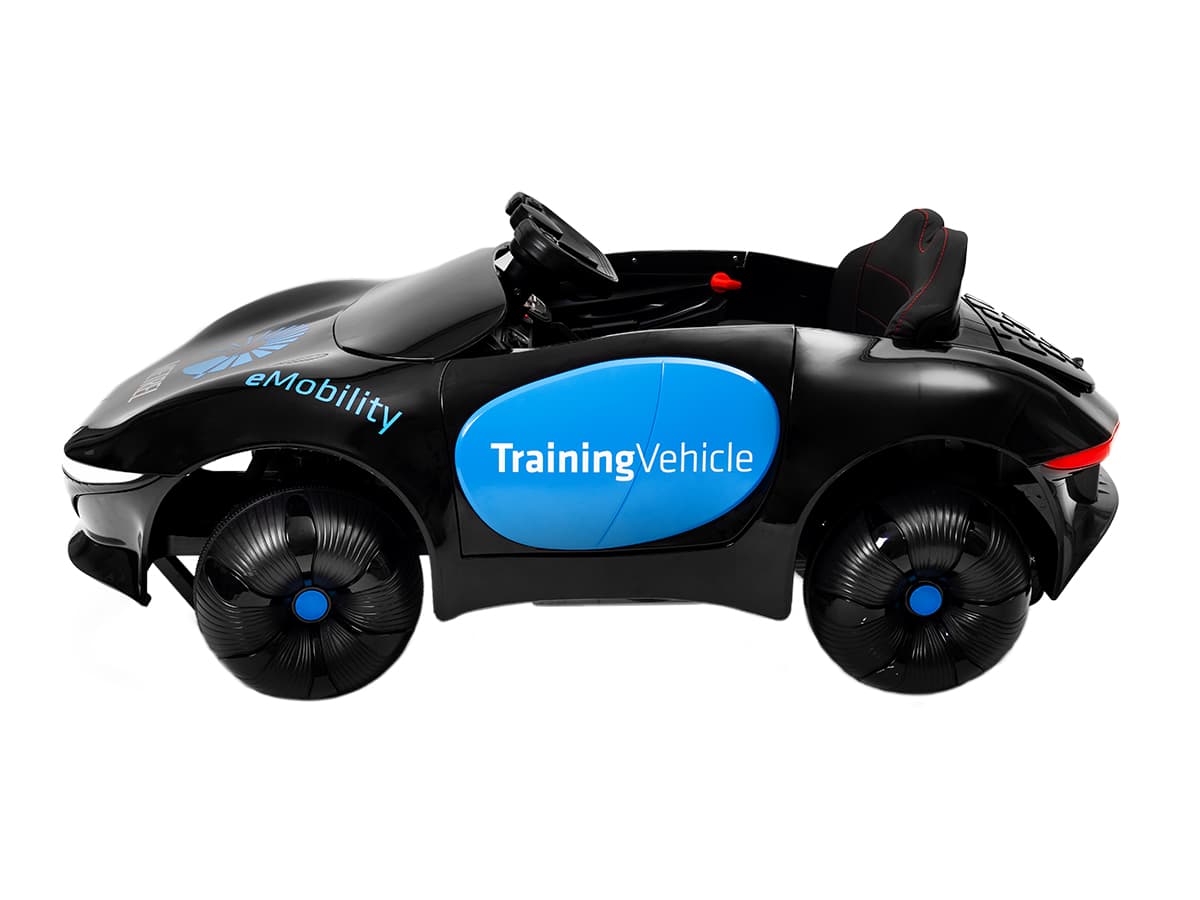

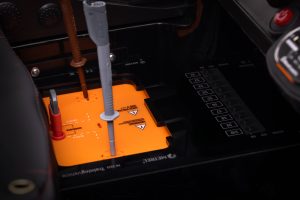
Additionally, the MI 3333 EV Training Vehicle can be used for training on how to approach orange high-voltage parts safely, including the use of a jumper.
It can simulate a high-voltage (high-power) 300 V vehicle battery (divided into two sub-batteries connected in series: 2 × 150 V) and its internal resistance (as low as 50 or 100 mΩ).
All this is provided for the purpose of training on how to assess the quality of batteries.
The MI 3333 EV Training Vehicle essentially teaches the importance of low resistances and bonding connectivity between the vehicle body, engine, inverter, and battery in general electrical safety (through the use of the 4-wire Kelvin method), and the importance of insulation quality (which can be evaluated on energized or de-energized parts).
SUPPORTED TESTERS
• MI 3132 EV Tester
• MI 3288 Earth Insulation Tester
• MI 3144 Euro Z 800 V
• MI 3155 EurotestXD
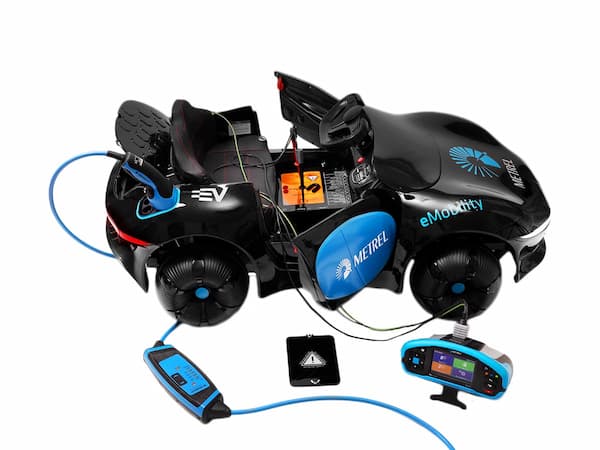
TRAINING FUNCTIONALITIES AND FEATURES
-
Electrical vehicle (EV) system simulating a fully operational electric vehicle and its safety devices.
-
Approaching orange parts with care (special warnings) and using protection methods, barriers, and a jumper.
-
Safety training on working with a high-voltage battery.
-
Charging from single-phase or three-phase EV AC sockets.
-
High-voltage battery failure, BMS A and B in error.
-
High-voltage battery AB internal resistance measuring and comparing, with simulated fault on the B battery.
-
High-voltage lines, engine, or battery positive terminal to ground insulation failure.
-
High-voltage lines, engine, or battery negative terminal to ground insulation failure.
-
AC charging socket insulation failure.
-
AC charging installation cable failure on line 1 or line 2 (internal cables).
-
Grounding and bonding equalization problems between the car’s body, engine, inverter, and REESS battery.

RECOMMENDED SAFETY
EQUIPMENT
• Cotton Safety gloves • Voltage safety gloves • Arc rated gloves
• Helmet with shield